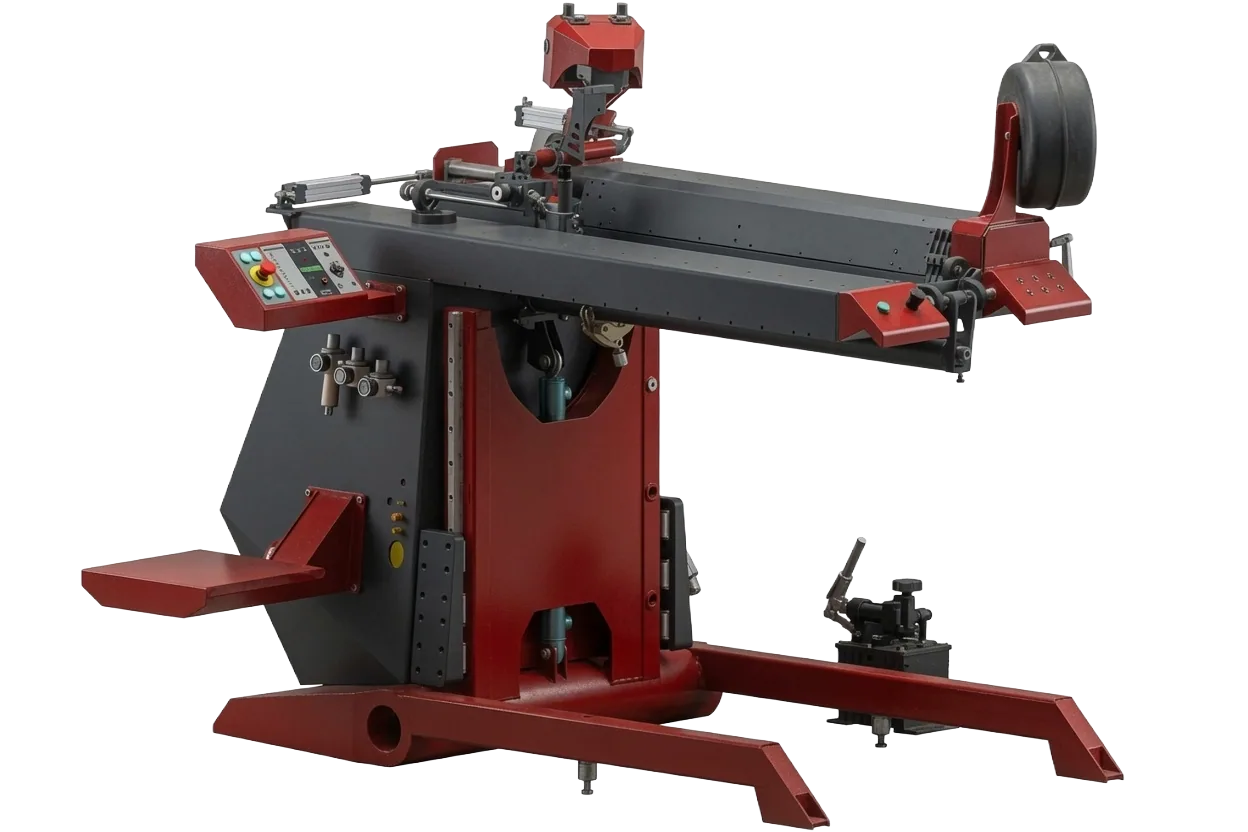
FINGER 1100 TPL is a linear welding machine for longitudinal welding on a copper backing bar, with double-sided clamping of weldments up to 1100 mm long and controlled weld-root protection with forming gas through the CascadeGas system. The steel central block is supported by two ergonomically shaped supports and houses all electronic components and the cooling system. The machine is designed for TIG AC/DC, Plasma AC/DC, and LASER welding of mild steels, alloy and non-alloy steels, CrNi steel, copper, aluminum, titanium, galvanized steel, aluminized steel, and other suitable materials.
The support arms are welded steel half-shell spatial structures with controlled flexibility. Both are fixed to the central block, which supports and secures the mandrel, while the right arm carries the linear guideways for the torch carriage. The weldment is pressed against the mandrel by pneumatically actuated pressure levers with transversely adjustable CuCrZr clamping segments. As a custom-made solution, stainless steel segments can be supplied, for example for welding of aluminum and improved cooling after welding.
The machine is designed for products up to 1000 mm in diameter. With an optional hydraulic lifting mechanism, the maximum diameter can be increased to 1500 mm. The mechanism runs on linear guides and is supported by a robust welded base with a tubular column and two stabilizing supports. Welding fume extraction is integrated directly into the machine structure without negatively affecting the welding process, which is especially beneficial when welding galvanized materials. The extraction connection has a diameter of 100 mm.
The mandrel is made of low-alloy steel with high flexural strength. A precisely machined CuCrZr backing bar with internal liquid cooling is mounted on it. The CascadeGas system is integrated into the backing bar to reduce shielding gas consumption while protecting the weld root. For aluminum welding, the backing bar can also be supplied in stainless steel.
The machine is equipped with pressure levers featuring a drift function and pressure force regulation referred to as DriftControl SET. On the right side of the clamping system, the first sheet edge is centered by the centering bar and then clamped, with clamping pressure adjusted by a separate reducing valve. The left side uses pressure levers with drift function and pressure force regulation. These levers on the left side are clamp simultaneously, while the main clamping pressure is adjusted by another reducing valve. Each pressure lever can be also mechanically adjustable in five steps to set the drift force, moving the second sheet edge towards the first already clamped edge. After clamping, the mechanism presses and slides the second edge to minimize the gap and keep it consistent and in the same position along the welded sheet metal.
Gas management consists of three independent circuits: torch gas, weld-track after-cooling, and forming gas for root protection. The forming gas circuit uses the CascadeGas system, which automatically switches the gas between individual sections according to the current torch position, protecting only the required length of the weld root. This can reduce forming gas consumption by up to 80%. All gas circuits are equipped with precise flow meters and control valves.
The torch carriage has a pneumatically controlled torch holder that can be parked horizontally for easy visual inspection of torch parts. Longitudinal movement is provided by a backlash-free drive combining a servomotor, planetary gearbox, and belt drive. Torch positioning has a repeatable accuracy of 0.2 mm. Welding speed ranges from 10 to 300 cm/min, with a rapid traverse speed of 600 cm/min.
The machine is controlled by the LCS 06 control system, specially designed for longitudinal welding. It provides advanced functions for the complete longitudinal welding process, including UP/DOWN logic and communication with the welding source.
The linear welding machine is designed for pipes, flues, suction pipes, galvanized pipes, and other products suitable for longitudinal welding. It can operate in manual or automatic mode and provides a high level of automated functions, including functions designed to increase working productivity.