
Assembling Line ASSEMBLER
Computer-controlled assembly line for alignment, assembling and welding of large tanks and heavy sections.
Request similar solution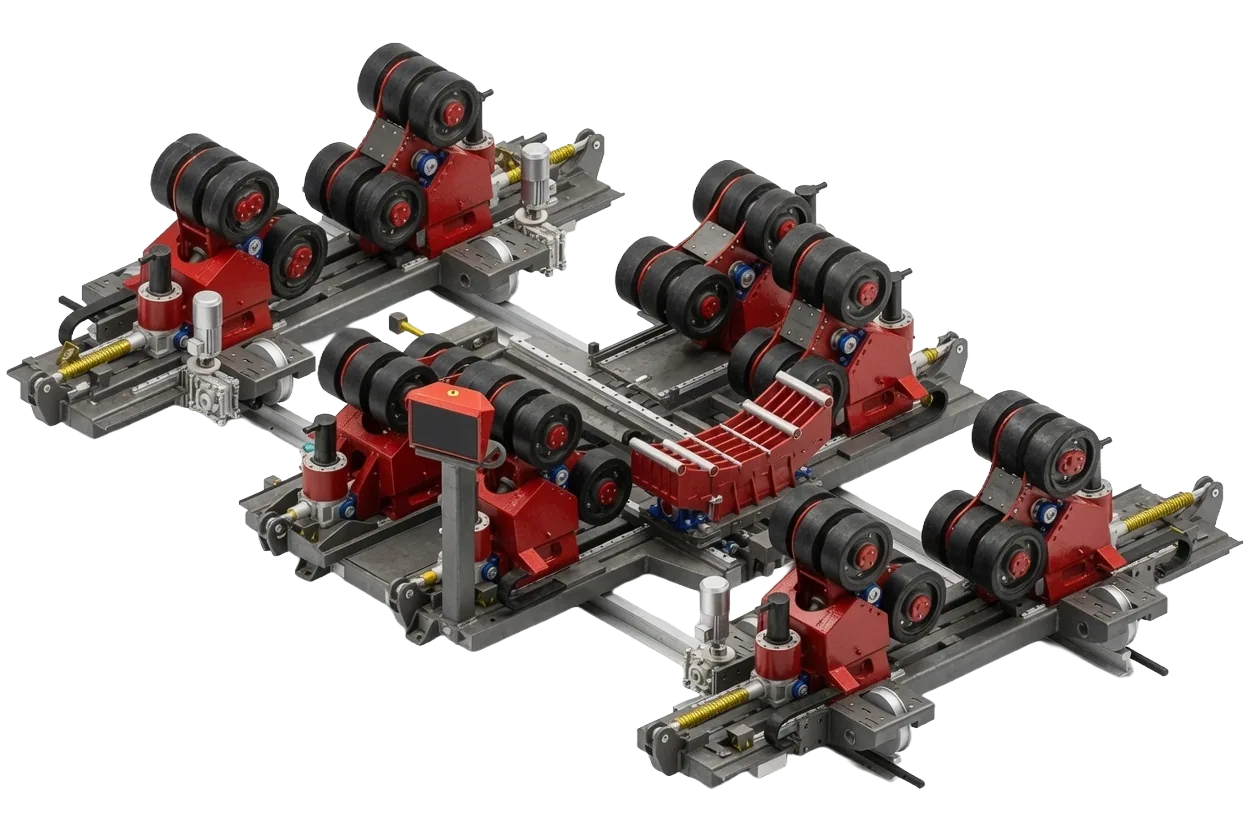
ASSEMBLER CONTROL WELDING is a custom-built, computer-controlled assembly line designed for assembling and welding large tanks, tank sections, tubular beams, columns and other heavy components.
The system is suitable for products with diameters up to 5000 mm and a maximum load of 25,000 kg. Its automated alignment and positioning functions simplify preparation, assembly and welding, making it suitable for integration into heavy-industry production lines.
Due to the complexity of the system, it is supplied only as a bespoke project. The final technical configuration and feasibility are determined after detailed consultation based on the product parameters, application requirements and customer production program.
The production line consists of three mechanically independent sections with four pairs of roller units. All sections operate as one coordinated system and their movements are controlled according to the current assembly cycle.
The first section is mounted on steel wheels and moves freely along rails. It carries the first roller pair, equipped with twelve vulcanized-rubber rollers. The roller spacing is adjusted automatically by stepper motors, gearboxes and electrically released safety brakes.
The second section is fixed to the rails and carries the second and third roller pairs. A motorized support base, mounted on heavy-duty linear guides, moves the assembled tank as additional sections are added.
The second roller pair moves longitudinally through a range of 100 mm using hydraulic cylinders. This controlled movement, called DRIFT, enables accurate alignment when joining another tank section.
The second and third roller pairs each contain eleven vulcanized-rubber rollers and one CrNi steel roller. All rollers are driven by synchronized digitally controlled motors. Their spacing is adjusted automatically by stepper motors, gearboxes, ball screws and electric safety brakes.
An internal flux backing system is integrated into the second section. It supplies flux directly beneath the internal weld.
The third section is mounted on steel wheels and moves longitudinally along the rails by motorized drive. Its travel corresponds to the length of the assembled tank section.
This section carries the fourth roller pair, consisting of twelve driven vulcanized-rubber rollers. The roller spacing is controlled automatically using stepper motors, gearboxes, ball screws and electric safety brakes.
The flux backing unit is vertically adjustable and allows the contact pressure against the lower part of the tank to be set. Unused flux is collected and returned to the feeding system.
The operator station is located between the second and third roller pairs. A touchscreen display provides control of the complete system through a combination of automatic and semi-automatic working cycles.
TIG welding is used for tack welding of the assembled sections. Internal and external final welds are performed by a welding-tower system that can be configured for different welding technologies.
The ASSEMBLER system can be connected to a two-tower welding station through digital remote control. The control system and all electrical components are installed in two separate electrical cabinets.
- High incresement of productivity caused by elimination of delay time spent by manipulation and also incresement of welding quality because of precisely assembled parts.
- Possibility of welding inner and outer welds directly after the process of tacking without needs to manipulate with the tank, root is protected by fluxing pad.
- Sequential system of assembling and movement of the tank along the rails on the third part does not require to use the crane.
- Sophisticated system of sequential production of FIFO philosophy combined with fully manual controlling can cover all of the needs.
- High safety standards because of clamping of assembled parts in roller units, safety brake system and falling sensors.
Need a similar solution?
Tell us about your production process and our team will help you define the right machine, automation level or custom system.
Request consultation